
How to write an honoree profile people actually read
A simple formula for hall of fame and honor wall biographies that work on a touchscreen, with a template, word counts, and before-and-after examples.
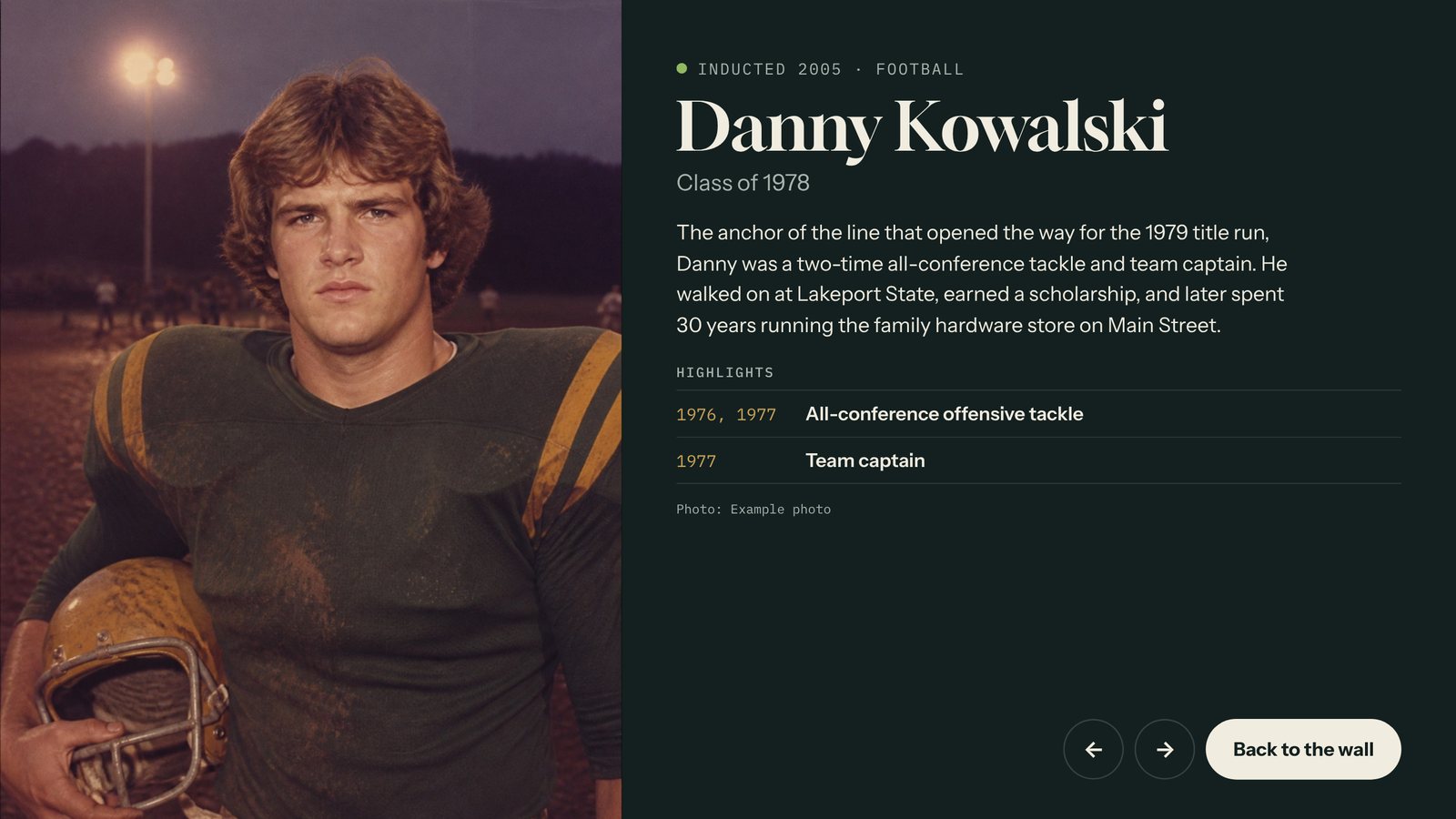
The hard part of a hall of fame or honor wall isn’t the touchscreen. It’s the writing. Most profiles end up as either a single line (“Class of 1978, football”) or a 600-word speech from the induction dinner. Neither gets read.
Here’s a formula that works on a screen, whether you’re honoring athletes, veterans, alumni, or volunteers.
The five pieces of every profile
Give every honoree the same five pieces, in the same order:
- Name as it should appear, including a nickname in quotes if everyone knew them by it
- Year or era: class year, induction year, or years of service
- Category: sport, branch, field, or group, matching your filters
- A short bio of 60 to 120 words
- Three to five highlights: the facts and stats, one per line
Splitting the bio from the highlights is the most useful thing you can do. The bio tells the story. The highlights carry the numbers. Visitors who want the stats can scan them, and everyone else can read the story without wading through them.
Write the bio in three sentences or so
A good touchscreen bio answers three questions:
- Who were they? One line that places them: position, role, or era.
- What did they do? The one or two achievements that earned the honor.
- Why does it still matter? A record that stands, a program they built, a person they inspired.
That’s it. If you have more, put it in the highlights or a video.
Before and after
Before (too short):
Jim Kowalski, Class of 1978. Football, basketball, track.
Before (too long):
Jim Kowalski was born in 1960 and grew up on Mill Street, where he first played football with his brothers in the yard behind the family hardware store. He entered Riverbend High in 1974 and immediately made an impression on Coach Harlan, who later recalled… (and 400 more words)
After:
A three-sport athlete who never left the field, Jim Kowalski led the Rivermen to their first conference football title in 1977 as a two-way lineman. He went on to coach at Riverbend for 31 years, where his teams won four more conference titles. The weight room he raised money for still carries his name.
Highlights:
- All-State lineman, 1977
- Conference champion, 1977
- Head football coach, 1986 to 2017
- Inducted 2019
The “after” is 58 words. It says who he was, what he did, and why he still matters, and the numbers live in the highlights where they’re easy to scan.
Tips that make a wall feel professional
- One voice. Have one person write or edit every profile, even if the facts come from many sources.
- Same order every time. Achievement first, then legacy. Don’t open half the bios with a birthplace and the other half with a record.
- Past tense for the past. “She set the record in 1991.” Present tense only for what’s still true: “The record still stands.”
- Specific beats glowing. “Ran the 400 m in 47.9 seconds” says more than “an incredible talent.”
- Spell out abbreviations the first time. Not every visitor knows what “All-RVC” means.
- Check names with families. Spelling, nicknames, and maiden names matter more on an honor wall than anywhere else.
Photos and video
Every profile should have one good photo. A portrait from the era is ideal, and an action shot works great for athletes. Crop it so the face fills a good part of the frame. Small faces in a big team photo don’t read on a kiosk.
Video is a bonus, not a requirement. A one-minute clip from the induction ceremony, a highlight reel, or a recorded interview gives a profile real life. For a kiosk, upload the video file rather than a link, so it plays even without internet.
Put it all in one spreadsheet first
Before anyone builds anything, collect every profile in a spreadsheet with a column for each of the five pieces. You’ll spot gaps right away, like missing photos or a bio that’s three times longer than the rest, and you can import the finished sheet straight into the Tellcase Honor Wall template.
Good profiles are what turn a list of names into a wall people stop at. Write them short, keep them consistent, and let the highlights carry the numbers.
Quick answers
How long should a hall of fame bio be?
For a touchscreen, 60 to 120 words. That's enough to say who the person was and why they matter, and short enough to read standing up. Put details like stats and awards in a separate highlights list.
What should a hall of fame profile include?
A name, a year or era, a category, one good photo, a short bio, and three to five highlights. Consistency matters more than length, so give every honoree the same pieces.
Should a hall of fame bio be written in past or present tense?
Use past tense for what the person did ("She set the school record in 1991") and present tense only for what's still true ("The record still stands"). Avoid mixing them in one sentence.
Who should write honoree profiles?
One person, or one person editing everyone else's drafts. A single voice makes the whole wall feel professional, even if the facts come from families, coaches, and archives.