
Digital honor wall ideas for museums: veterans, founders, and local legends
Five ways museums and historical societies use a touchscreen honor wall, plus how to set one up so visitors can find a name fast and staff can keep adding to it.
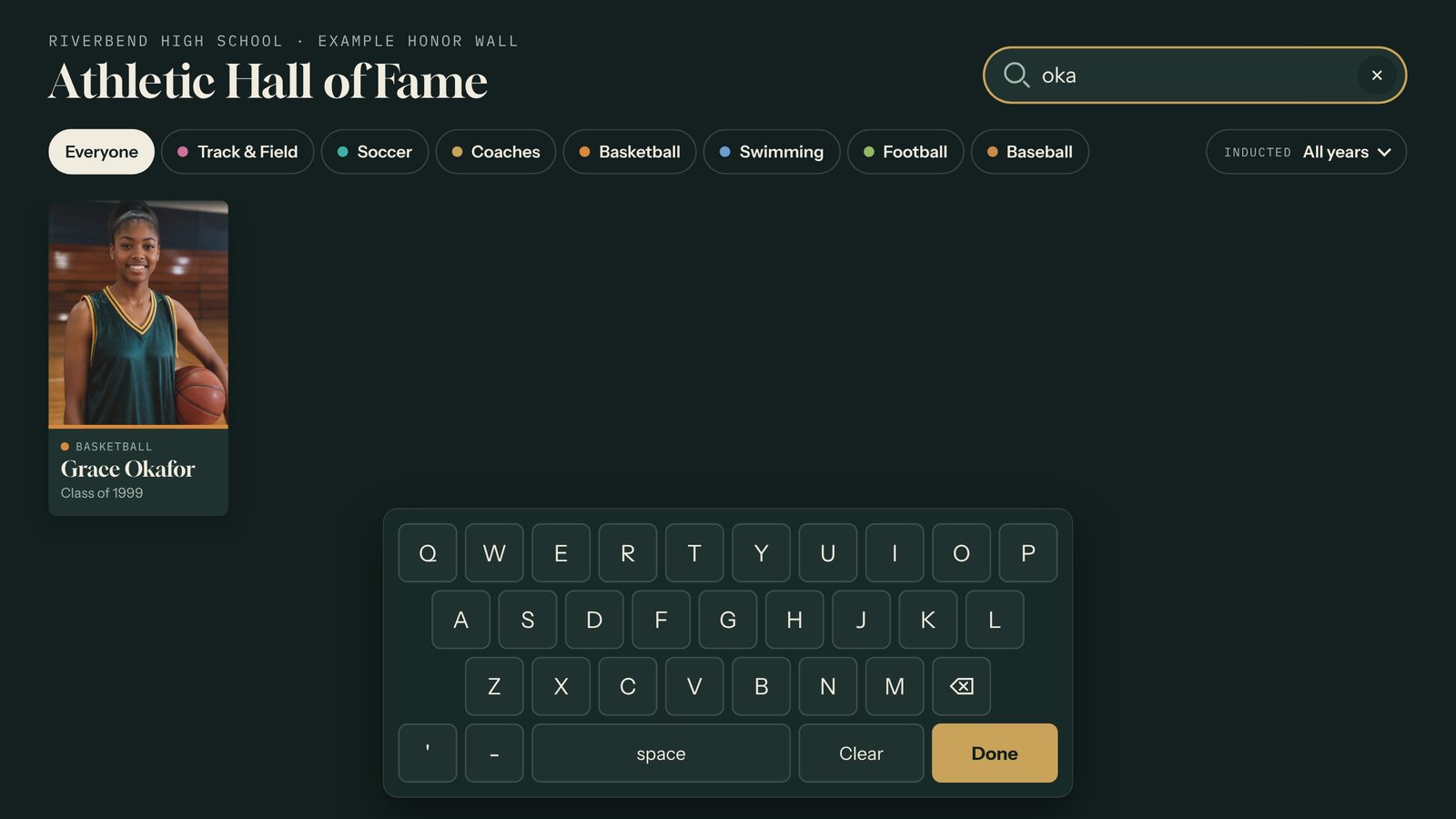
Every community has names worth remembering. The question is how much room you have to remember them. An engraved wall holds a name and maybe a year. A touchscreen honor wall holds the photo, the story, and the reason the name is there at all.
Here are five ways museums and historical societies use one, and how to set it up well.
1. A veterans honor roll
This is the most common, and often the most moving. A county museum can list every resident who served, from the Civil War forward, with:
- Name, branch, and years of service
- The conflict or era
- A photo, often from a family album
- A short biography, letters home, or a recorded interview
Filters that work: branch of service and conflict. Name search matters more here than anywhere else, because many visitors walk up looking for one specific grandparent.
2. Founders and early settlers
For a historical society, the founding families are the backbone of the collection. An honor wall lets each family have a page: who arrived, when, what they built, and where their land was. It pairs well with a touchscreen timeline of the same era.
3. Local legends
The athlete who went to the Olympics. The author who wrote about your town. The doctor who delivered half the county. A “local legends” wall gives visitors a reason to linger and gives longtime residents something to point at.
Filters that work: field (sports, arts, medicine, business) and decade.
4. Donors and members
Donor recognition doesn’t have to be a list of names on a lobby wall. A digital wall can tell visitors what each gift made possible, like the gallery a family funded or the artifact a donor gave. It also makes adding names each year easy, which matters to the development office.
5. Volunteers and staff
Small museums run on volunteers. An honor wall for long-serving docents, board members, and staff is a simple way to say thank you in public, and new volunteers love seeing who came before them.
How to set it up
Whatever you’re honoring, the setup is the same.
Gather consistent profiles. For each person: name, a date or era, a group or category, a photo, a 60 to 120 word bio, and three to five highlights. A spreadsheet with one row per person keeps everyone on the same footing, and Tellcase can import it directly. Our guide to writing honoree profiles has examples.
Choose two filters, not five. One “who” filter (branch, field, family) and one “when” filter (decade, conflict) cover almost every honor wall. More than that and visitors stop using them.
Make search easy. In Tellcase, the Honor Wall template includes name search with an on-screen keyboard, so visitors can type a surname and go straight to the person.
Give the screen something to do between visitors. When nobody is touching it, the Honor Wall template shows a welcome screen with the wall gently moving behind it, which draws people over from across the room, and it clears the last visitor’s search.
Plan for no internet. Memorial halls and historic buildings often have thick walls and no Wi-Fi. A Tellcase kiosk can run from an offline package and be updated with a USB stick.
Keep it growing
The best honor walls are never finished. Families will bring in photos, letters, and corrections once they see the wall, so plan for it:
- Put a small sign beside the kiosk inviting families to share a story or photo
- Name one staff member or volunteer to add submissions each month
- Fix misspellings the same day. People notice.
An engraved wall is done the day it goes up. A digital honor wall gets better every time someone walks up and says, “That’s my grandfather.”
Want to see the Honor Wall template with example content? Join early access and we’ll show you.
Quick answers
What is a digital honor wall?
A digital honor wall is a touchscreen that lists people worth remembering, such as veterans, founders, or volunteers. Visitors search by name or filter by group or decade, then tap a name to see a photo, a short biography, highlights, and sometimes video.
How is a digital honor wall different from an engraved wall?
An engraved wall holds a name. A digital wall holds the story behind it, and it never runs out of room. Staff can add new names, fix a misspelling, or add a photo a family brings in, without ordering a new plaque.
Can families add information to an honor wall?
Families usually send photos and stories to the museum, and staff add them. With Tellcase, updating a profile is like editing a form, so a volunteer can do it the same day.
Does a digital honor wall work without Wi-Fi?
Yes. A Tellcase kiosk can play from an offline package copied over on a USB stick, which suits memorial halls and historic buildings with no reliable internet.